
Now at the centre of international attention for training in underground and complex environments, La Carona is a strategic asset that Smart Revolution Security had already integrated into its HEAT programmes when such scenarios were still far from the spotlight.
The future of training is increasingly shaped by a simple reality: the environments in which people may be called upon to operate are becoming more complex, more constrained and less predictable. Recent conflicts have brought renewed attention to urban and underground environments, degraded infrastructure, disrupted communications and situations in which traditional technological advantages can quickly become less reliable. As a result, military and security organisations around the world are rethinking not only what to prepare for, but also where and how to train.
In Italy, one facility is attracting growing international attention: La Carona, the extraordinary underground complex at Fornovo di Taro, near Parma. La Carona is now emerging as an important environment for the development of new training capabilities. International defence media have reported growing interest from armed forces and special operations units, while special units of the Italian Army, the Italian Navy, the Italian Air Force and the Carabinieri, together with the National Fire and Rescue Service (Vigili del Fuoco), have used the facility as part of developing specific underground warfare capabilities.
For Smart Revolution Security, however, La Carona is not a recent discovery. For years, we have leveraged this extraordinary environment as the primary location for the practical component of our Hostile Environment Awareness Training (HEAT) programmes. Long before underground environments became a central theme in the contemporary training debate, we had recognised something fundamental about La Carona: its physical characteristics make it an exceptional environment in which to expose participants to complexity, uncertainty and controlled operational stress.
From strategic infrastructure to a training environment for the future
La Carona has never been an ordinary facility. Built in the 1930s as an underground fuel depot for military aviation, the installation was designed to withstand air attacks. Beneath the hills of Fornovo di Taro lies a vast underground system made up of five enormous cylindrical cisterns connected by approximately 2 km of tunnels and passageways. The complex remained in military use for decades before being decommissioned. Rather than being left to decay, it was recovered and given a new operational purpose thanks to the work and resources of a group of private individuals, making La Carona a truly unique initiative today. Its distinctive architecture is now its greatest training asset.
The underground environment creates conditions that are extremely difficult to reproduce artificially: darkness, confined and compartmentalised spaces, complex movement, limited visibility, reduced radio communications and the absence of reliable GPS signals. The facility can also be adapted through controlled lighting, sound and smoke, while modern technologies, including drones, robotic platforms and other specialist systems, can be integrated into exercises.
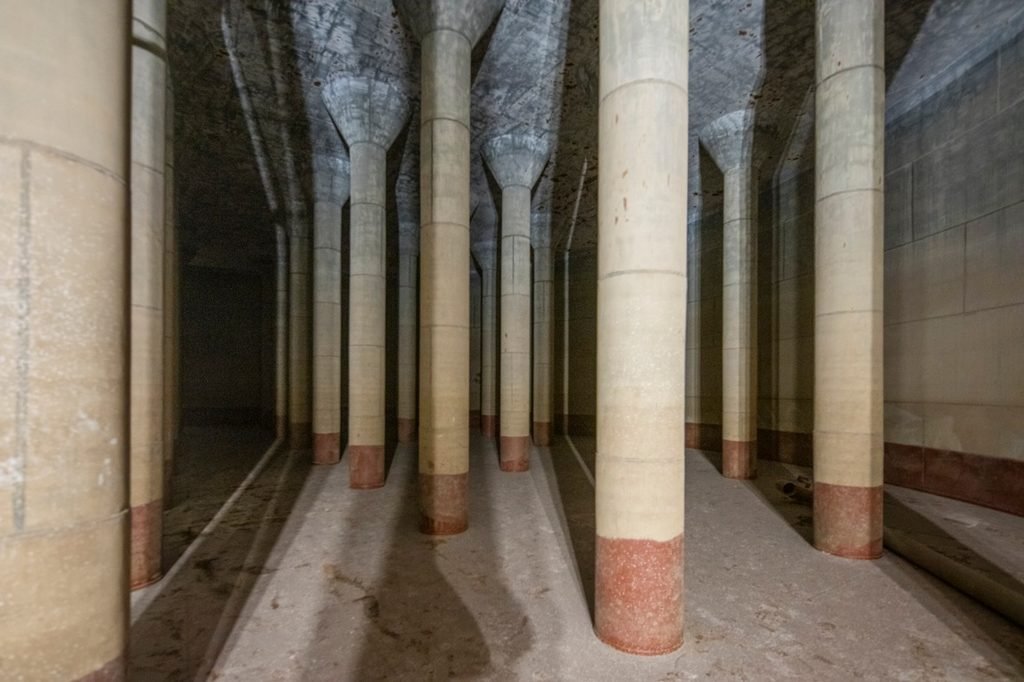
What was once designed to protect strategic infrastructure from air attack has thus become something very different: a highly adaptable environment in which contemporary operational complexity can be reproduced and studied.
The international training community turns to La Carona
Interest in La Carona is no longer confined to Italy. In June 2026, Defense News reported that personnel from 17 countries had already trained at the facility. Those cited include the United States, Belgium, France, Germany, the Netherlands, Poland, Greece and Turkey, alongside the emerging specialist capabilities in underground operations of several units of the Italian Armed Forces.
This international attention reflects a broader shift. Recent operations in Ukraine and Gaza have demonstrated the enduring strategic relevance of underground infrastructure: tunnels, industrial complexes, bunkers and other subterranean spaces can radically alter the conditions in which people and technologies operate. The Italian Army has responded to this evolution by developing a dedicated Underground Warfare capability, and La Carona has become part of that journey.
In February 2026, sappers of the 8th Paratroopers Sappers Regiment “Folgore” completed a training cycle at La Carona aimed at validating procedures and testing new equipment for underground operations. The activity marked the achievement of Initial Mission Capability by the newly established 184th Paratroopers Sappers Battalion “Nembo”.
Just a few weeks later, this progression continued. During exercise Cerbero 2026, held at La Carona in April, the 184th Battalion achieved Full Mission Capability. The training covered doctrine, operating procedures and advanced technologies for environments characterised by darkness, confined spaces and restricted movement. The presence of the Minister of Defence and the Chief of Staff of the Italian Army during the final phase of the exercise further underlined the institutional importance attached to this emerging capability.
The direction is clear: complex and underground environments are becoming an increasingly important component of future training.
Smart Revolution Security was already there
For Smart Revolution Security, this evolution carries particular significance. That is because our training activities at La Carona did not begin after underground environments became a prominent topic in the international defence debate. We were already there.
For years, La Carona has been integrated into the practical phases of our Hostile Environment Awareness Training programmes. Our objective is, of course, fundamentally different from military Underground Warfare training. HEAT is not combat training. Our programmes are designed for civilian professionals who may travel or work in fragile, unstable or hostile environments: humanitarian staff, journalists, business travellers, institutional personnel and other professionals whose work may expose them to rapidly changing security conditions. Yet there is an important principle shared by these different training needs: people need to experience complexity before they are called upon to manage it in the real world.
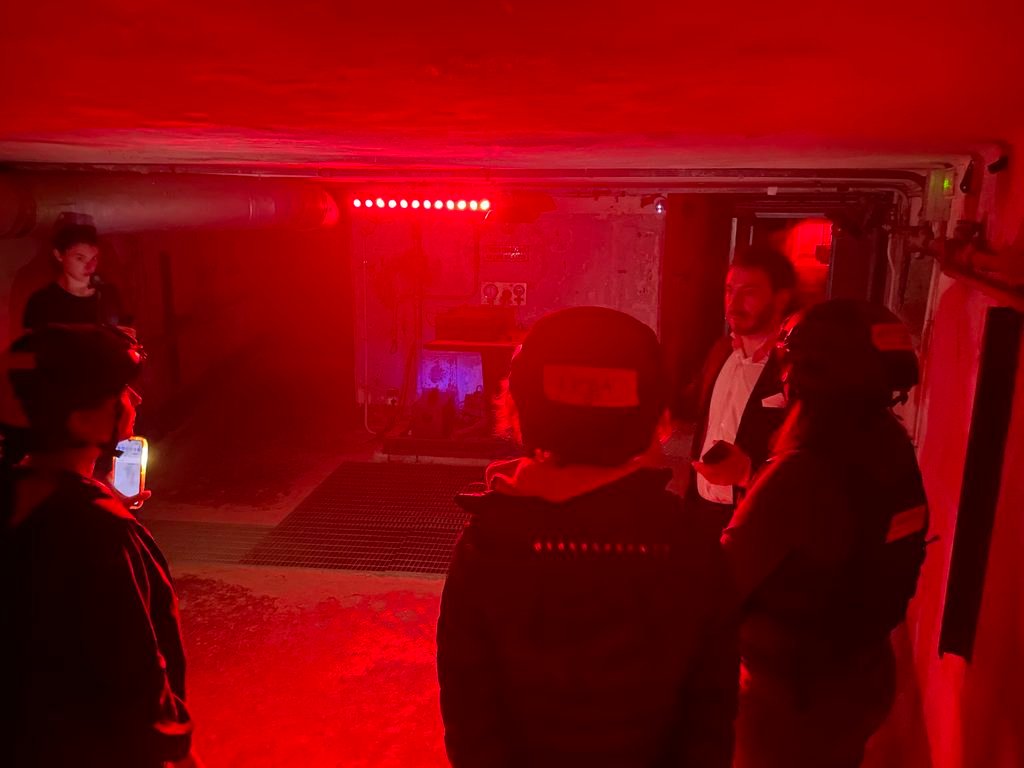
This is precisely what we recognised in La Carona. Its value has never simply been the visual impact of entering an underground facility. Its value lies in what happens to human behaviour when the usual reference points begin to disappear.
When the environment becomes part of the training
Inside an underground environment, seemingly simple tasks become more demanding. Orientation changes. Communication becomes more difficult. Visibility decreases. Familiar spatial references disappear. Participants become more reliant on teamwork, information management and decision-making. All of this creates an extremely effective learning environment.
During a HEAT programme, the goal is not to teach participants how to conduct military operations underground. Instead, the environment allows instructors to introduce realistic constraints into scenarios involving situational awareness, communication, movement, decision-making and response to unexpected events. Participants must process incomplete information, maintain awareness of their surroundings, communicate effectively and adapt as circumstances change. These are exactly the skills that become decisive in a real crisis. The underground facility therefore becomes far more than just a training location.
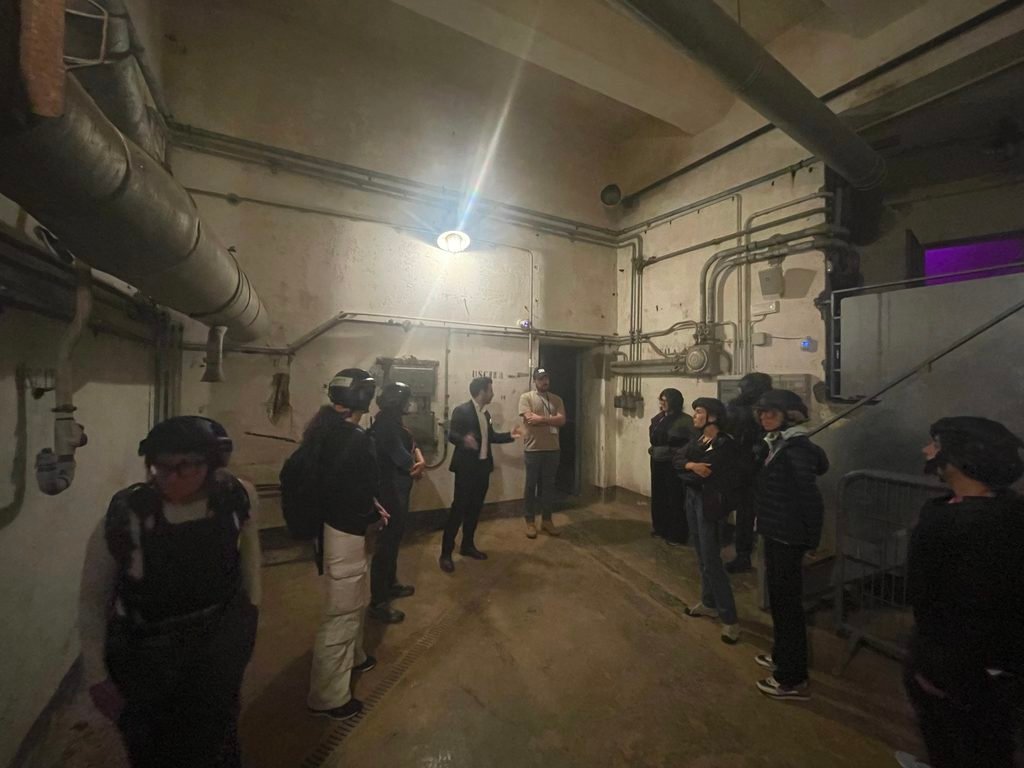
There is an important distinction between making training spectacular and making it effective. A realistic environment has limited educational value unless it serves clearly defined learning objectives.
For Smart Revolution Security, the purpose of immersive training is not to create stress for its own sake. It is to introduce controlled complexity. Participants first acquire knowledge, procedures and tools. They are then placed in environments where they must apply those skills while some of the conditions they normally rely on are progressively taken away. Communications may become more difficult. Visibility may deteriorate. Routes may change. Information may be incomplete. Plans may need to be reassessed. Participants thus move from knowing what should be done to experiencing first-hand what it means to make decisions when the situation is no longer predictable. This transition is one of the most important objectives of effective hostile environment training.
La Carona’s evolution also reflects a broader transformation in professional training. Traditional classroom training remains essential. It provides knowledge, frameworks and procedures. But knowledge alone does not create preparedness. The training environments of the future will increasingly need to combine theoretical learning with immersive, scenario-based and adaptable experiences in which participants can put their judgement and behaviour to the test.
This principle extends well beyond the military domain. Humanitarian organisations operate in contexts affected by conflict, natural disasters and infrastructure disruption. Journalists may work in areas marked by civil unrest or rapidly deteriorating security conditions. Corporate staff travel to countries where political instability, transport disruption or sudden crises can radically change operating conditions. In each case, the specific risks differ. But the fundamental requirement is strikingly similar: the ability to remain effective when normal conditions break down.
From historic underground facility to a laboratory for preparedness
There is another reason why La Carona is unique. Its transformation shows how infrastructure designed for the strategic needs of another era can take on an entirely new relevance. Analyses of the facility have described the underground complex almost as a subterranean city: chambers, corridors, vertical connections and large interior spaces form an environment whose scale and complexity would be extremely difficult to recreate through a purpose-built simulation. Rather than letting this infrastructure disappear, its recovery has preserved its historical and engineering identity while giving it a contemporary training function. The result is a rare combination: authentic infrastructure, adaptable scenarios and modern training methodology. It is a combination that is now attracting international attention.
For us, it has been part of our training approach for years. La Carona’s growing prominence therefore matters to Smart Revolution Security for reasons that go beyond the facility itself. It confirms a principle that has shaped our approach to training from the very beginning: effective preparedness is not about reproducing yesterday’s crisis, but about understanding how operating environments are evolving and preparing people before those changes become evident.
When we began integrating La Carona into our HEAT activities, the aim was not to predict a specific conflict or a particular operational trend. It was to recognise the value of an environment capable of challenging participants in ways that conventional training facilities could not.
Today, military organisations are increasingly examining those same environmental characteristics through the lens of Underground Warfare. Our mission remains different, but the training philosophy underpinning our work has remained essentially the same: preparing people for complexity before complexity becomes reality.
Preparing today for tomorrow’s environments
No training facility can reproduce every possible crisis. Nor should it try to. The aim of effective security training is not to give participants a predetermined answer for every possible scenario. It is to develop the awareness, judgement, resilience and adaptability they need when the situation they face differs from the one they expected.
That is why places like La Carona matter. They remove certainties. They challenge assumptions. They force participants to communicate. They make even seemingly simple decisions harder. And, within a controlled training environment, they allow people to experience uncertainty before it has real consequences. Today, La Carona is increasingly recognised, in Italy and internationally, as an environment with significant potential for the future of training. For Smart Revolution Security, it has already been part of that future for years.
And this, ultimately, is what preparedness means to us: not reacting to the next trend, but recognising how the operating environment is changing and preparing people before that change becomes the new normal.